Other Dwarfs
|
A couple of the other dwarf cichlids species I currently have are Nannacara anomala, Laetacara sp. "Purple/Gold", Telocichla monogramma, Biotecus opercularis, Dicrossus filamentosa, and Mikrogeophagus altispinosa (The Bolivian Ram). |
Nannacara anomala -
|
I had the hardest time getting the Nannacara anomala to spawn for the first time. Then, I had the hardest time getting them to stop spawning. The females turned out to be very good egg/fry protectors with more surviving from each successive spawn. Once they got started, water parameters didn't seem to matter. It took some rather soft, acidic water to get them started. I kept them in a 15 gallon tank with 2 inches of peat moss under a couple inches of gravel. Planted it with a couple crypt. wendettii, which took off in the tank and pretty much over ran it, and tossed in a couple terra-cotta flower pots. The anomala aren't really cave spawners like the Apistogramma, but the females would lay their eggs in or on the pot. The male was the bully of the tank, until there was a spawn. That is how I learned there were eggs in the tank, the male would be hiding behind the filter intake or in the crypt leaves. Female anomala on eggs are rather mean to each other. After the fry became free swimming, he was allow to come out of hiding. Presumably to patrol the territory. If he got near her or the fry, he was quickly reminded who was in charge. After a few weeks, I normally pulled the fry and the female went back to being timid while the male pushed everyone around. |
|
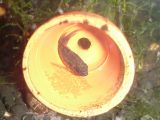
Female anomala in breeding dress. Notice the celery stalk sized stems of the crypts. They seem to love the peat moss. |
Another female over her new eggs. |
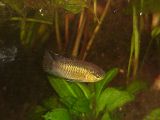
The male. One of their common names is "The Golden Dwarf" and this pretty much descibes his color. |
Laetacara sp. "Purple/Gold" -
|
Laetacara sp. "Purple/Gold" is a nice dwarf. Very undemanding although the males can be hard on each other when a ripe female is nearby. They have spawned for me under a number of conditions and different water parameters. About the only thing that was really constant was the water was a hair below neutral and the temperature was in the low 80's. The spawned in community setups, as a single pair in a 10 gallon bare bottom tank, and in a 15 gallon tank I tossed them in with some Apisto. cacatouides. They are closely related to the more common L. curviceps and one of my favorites, L. dorsiger. |
|
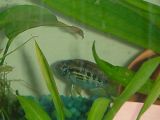
This is the only picture I have of them so far. This is a female. The older males develop a hump on their forehead. |
Mikrogeophagus altispinosa -
|
The Bolivian Ram has been a pleasant suprise. Reputed to be a timid, wimpy little fish, I have found mine to be just the opposite. They are always out and about and don't take any grief from the Apistogramma agassizii they share a tank with. They spawn rather regularly and make better parents than their cousins, M. ramirezi. Mine routinely raise their fry well past the free swimming stage, at which point I normally pull the fry to give them a break from the stresses of parenting. |
|
Female guarding eggs |
Same female, a little better picture |
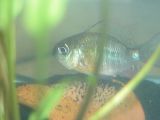
Her mate helping keep the Apistogramma agassizii at a safe distance. |
Same male |